
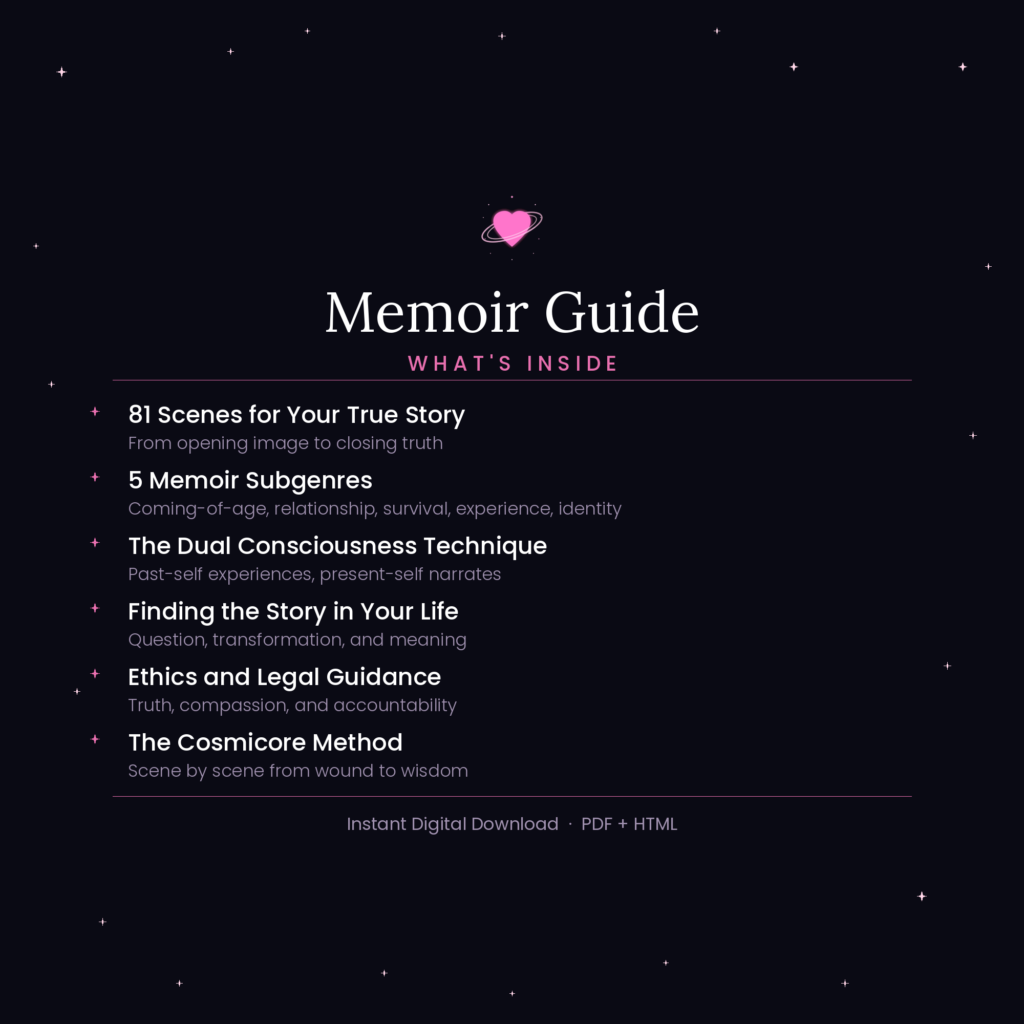
The Memoir Guide is a complete scene-by-scene roadmap for writing narrative nonfiction about your own life — the genre that transforms lived experience into crafted story. Memoir is not autobiography. Autobiography says: “This is what happened to me.” Memoir says: “This is what happened to me, and here is what it MEANT.” The difference is the difference between a timeline and a story, between a report and a revelation, between “I was born in 1987” and “I was born into a family that was already breaking apart, though I wouldn’t understand the sound of the breaking for another twelve years.”
Memoir uses all the tools of fiction — character, scene, dialogue, pacing, structure, theme — to tell a true story. The story doesn’t have to be famous or dramatic. The most powerful memoirs are often about ordinary lives examined with extraordinary honesty. You don’t need to have climbed Everest or survived a war (though those make fine memoirs). You need to have LIVED something, FELT something about what you lived, and been CHANGED by what you felt. The living is the raw material. The feeling is the theme. The change is the arc. This guide teaches you how to find all three in your own experience and shape them into 81 scenes that will make a reader who has never met you feel as though they’ve lived inside your skin.
The Memoir Subgenres
- Coming-of-Age Memoir — A specific period of growing up — childhood, adolescence, early adulthood — examined through the lens of the person you became. The transformation is from innocence to experience, from confusion to (partial) understanding. Books: The Glass Castle, Educated, Running with Scissors, I Know Why the Caged Bird Sings, Angela’s Ashes
- Relationship Memoir — A specific relationship — parent, partner, sibling, friend, mentor — explored as the lens through which you understand yourself. The other person is not the subject. The relationship is. Books: H Is for Hawk, The Year of Magical Thinking, When Breath Becomes Air, Crying in H Mart, Men We Reaped
- Experience Memoir — A specific experience — an illness, a journey, a career, a crisis, a project — used as the structural and thematic spine. The experience is both literally true and metaphorically resonant. Books: Wild, Eat Pray Love, Born a Crime, Between the World and Me, In the Dream House
- Identity Memoir — An exploration of a specific aspect of identity — race, gender, sexuality, class, disability, faith, culture — through personal narrative. The personal becomes political; the political becomes personal. Books: Hunger, Heavy, Redefining Realness, Minor Feelings, Just Kids
- Survival Memoir — A story of enduring something that should have destroyed you — addiction, abuse, illness, trauma, imprisonment, poverty — and the process of rebuilding. Books: A Million Little… (the controversy aside), Beautiful Boy, The Liar’s Club, Know My Name, The Body Keeps the Score (narrative sections)
What Makes Memoir Different from Fiction
Memoir uses fiction’s tools but operates under a different contract — the contract of truth. This contract creates both limitations and superpowers:
- You cannot invent. Every scene, every dialogue, every detail must be either literally true or a reasonable reconstruction of what was true. You can compress time, reorder events for clarity, and reconstruct dialogue from memory — but you cannot fabricate events that didn’t happen. The contract with the reader is: this happened. If it didn’t happen, the contract is broken, and the reader’s trust — the only currency memoir trades in — is destroyed.
- You are the protagonist AND the author. This dual identity is memoir’s greatest challenge: you must be honest about yourself (the protagonist) while also being strategic about yourself (the author). The protagonist-you is flawed, confused, sometimes wrong. The author-you selects which flaws to show, shapes the confusion into narrative, and creates meaning from the wrongness. The gap between who you were (the protagonist) and who you are now (the author) is where the memoir lives.
- Real people are characters. The people in your memoir are real — they have feelings, reputations, and the ability to be hurt by your portrayal. You must render them as three-dimensional characters (not villains, not saints, but humans) while also being honest about how they affected you. The tension between honesty and compassion — between telling YOUR truth and respecting THEIR complexity — is memoir’s most delicate craft challenge.
- The truth is your superpower. Fiction can invent any situation. Memoir has something fiction can never have: the weight of reality. When the reader knows this actually happened — this person actually said this, this moment actually occurred, this pain was actually felt — the emotional impact is multiplied by the knowledge that the narrative is carved from real life. The truth is not a limitation. It’s the source of memoir’s power. Lean into it.
The Memoir’s Contract with the Reader
The contract: “I will tell you something true about my life, and in the telling, you will recognize something true about yours.” The memoir reader doesn’t read your book because they care about you (they don’t know you yet). They read it because they suspect that your experience — however specific, however different from theirs — contains a human truth that resonates across the boundary between your life and theirs. The parent who reads a memoir about addiction recognizes the helplessness. The teenager who reads a coming-of-age memoir recognizes the confusion. The grieving person who reads a memoir about loss recognizes the specific weight of absence. Your specificity is what creates the universality. The more honestly and precisely you describe YOUR experience, the more powerfully the reader will recognize THEIR experience reflected in yours.
Finding Your Memoir’s Story
Before you write Scene 1.1, you must answer three questions:
- What is the experience? The specific period, event, relationship, or crisis your memoir covers. Not your whole life — a SLICE of your life with clear boundaries. “The year my mother was dying” not “my relationship with my mother from birth to present.” “The summer I walked 1,100 miles” not “my history of hiking.” “The decade I spent addicted and the first year of recovery” not “my entire life before and after.” The slice determines the memoir’s scope and pace.
- What is the transformation? How were you different after the experience than before it? What did you believe before that you no longer believe? What did you not understand before that you understand now? The transformation is your character arc — the same arc fiction demands, but drawn from your real psychological journey. “I believed I was unlovable; I learned I was loved in ways I couldn’t see.” “I believed strength meant never asking for help; I learned that asking for help IS the strength.” The transformation is your theme.
- What is the question? The question your memoir asks — not answers, ASKS — about the human experience. “How do we survive the people who are supposed to protect us?” “What happens to identity when the body fails?” “How do we forgive the unforgivable?” “What does home mean when home has been destroyed?” The question drives the reader’s engagement: they read to see how YOU answered it, knowing that your answer will help them think about their own.
Word Count and Structure
- Total memoir: 65,000–85,000 words. Memoir tends to be slightly shorter than fiction because every word must be earned by truth — padding is more visible in nonfiction.
- Per chapter: 2,400–3,200 words (3 scenes × 800–1,000 words)
- Scenes in memoir: A “scene” in memoir is a reconstructed moment from your life — a specific time, place, and interaction rendered with the vivid, sensory detail of fiction. Not summary (“that year was hard”) but scene (“I was standing in the kitchen when my mother said the sentence that split my childhood in two”).