
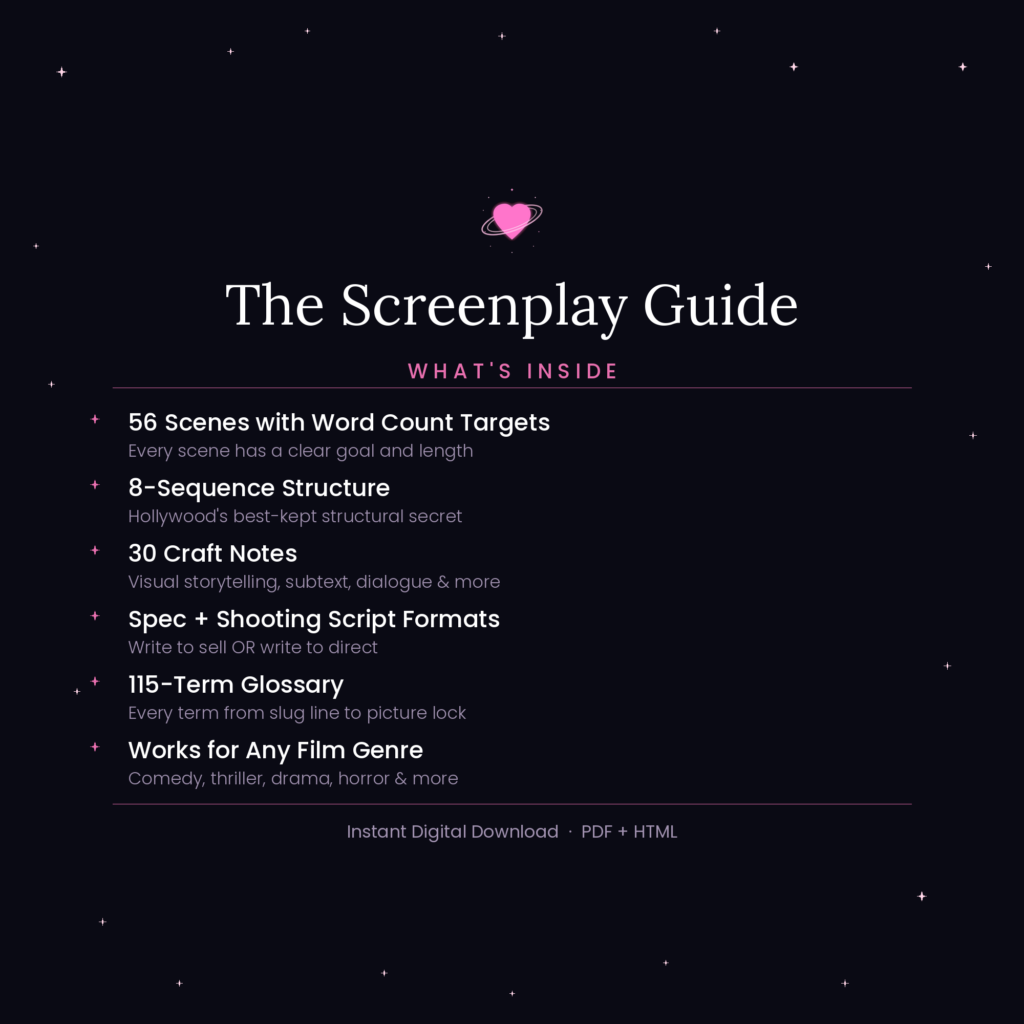
The Cosmicore Method’s Feature Film Screenwriting Guide
Unzip the download and you will find the terms, PDF and HTML file of the Feature Film Screenwriting Guide for any genre of SPECT or SHOOTING script.
This guide was made from a method that helps me write scene by scene. I hope it helps you. ⊹ ࣪ ˖
Introduction & The Cosmicore Method
The Screenplay Guide is the flagship screenwriting product in the Cosmicore Method library — a complete, genre-agnostic, scene-by-scene roadmap for writing a feature film screenplay that works. Not a screenplay that follows a formula. A screenplay with architecture: the structural engineering that supports any story, in any genre, at any budget level, with any cast. Whether you’re writing a romantic comedy or a psychological thriller, a war epic or a quiet indie drama, a horror film or a heist movie — the principles in this guide are the craft foundations that make films land.
This is not a genre guide. This is how screenplays work. The physics of visual storytelling. The architecture of screen characters. The engineering of cinematic tension. The craft that makes an audience lean forward in their seats, forget they’re watching a movie, and carry your characters in their minds for days after the credits roll.
Every principle in this guide applies to every genre. The scene-by-scene structure is a universal framework that you will adapt to your story, your characters, and your cinematic voice. The craft notes embedded in each scene teach the skills that separate amateur screenplays from professional ones — not through rules but through understanding. When you understand why a technique works on screen, you know when to use it and when to break it. This guide teaches the why.
What Is the Cosmicore Method for Screenplays?
The Cosmicore Method is built on one principle: a writer should never face a blank page without knowing what to write next.
The blank page is a structure problem, not a creativity problem. When you sit down to write and feel paralyzed, the problem isn’t your imagination — it’s that you don’t have a clear picture of what this specific scene needs to accomplish visually, emotionally, and structurally. The Cosmicore Method solves this by breaking the screenplay into 56 individual scenes, each with a clear narrative purpose. You never sit down to “write a screenplay.” You sit down to write one scene — a scene whose job you understand, whose place in the sequence you can see, and whose visual and emotional target you can feel. Then you write the next one. By the time you’ve written 56 scenes, you’ve written a feature film. And because each scene was built with intention, the screenplay has the invisible architecture that makes audiences feel the story is inevitable.
Why 8 Sequences & 7 Scenes?
The 8-Sequence structure is Hollywood’s best-kept structural secret — born in the era of film reels, when a two-hour movie required eight reels of film and screenwriters learned to write each reel as a self-contained mini-movie with its own arc and cliffhanger. The reels are gone but the architecture endures because it works: it breaks the intimidating 110-page screenplay into eight manageable segments, each with a clear dramatic function.
- 7 scenes build a sequence — each sequence is a mini-movie with its own setup (scenes 1–2), confrontation (scenes 3–5), and resolution with cliffhanger (scenes 6–7). The audience feels the rhythm of rising tension and release within each 12–15 minute segment, creating the propulsive momentum that keeps them in their seats.
- 2 sequences build Act One — the first quarter of the film. Establishes the world, introduces the protagonist, presents the central conflict, and locks the protagonist into the journey.
- 4 sequences build Act Two — the middle half of the film. Escalates the conflict through rising obstacles, develops relationships, produces the midpoint revelation, and drives the protagonist to their lowest point.
- 2 sequences build Act Three — the final quarter. Resolves the conflict, completes the character arc, and delivers the climax and emotional payoff the audience has been waiting for.
The structure is fractal: the same rhythm of setup → confrontation → resolution repeats at every level — inside each scene, inside each sequence, inside each act, and across the film as a whole. This creates a movie that feels simultaneously propulsive and inevitable. The audience always feels forward motion, and when the ending arrives, it feels like it couldn’t have gone any other way.
Page Count & Word Count
At an average of 2 pages per scene, the method produces a screenplay of 100–115 pages — the industry standard for a feature film. One properly formatted screenplay page equals approximately one minute of screen time. One page in 12-point Courier contains approximately 200 words (less for dialogue-heavy pages, more for action-heavy pages).
Target per scene: 1.5–2.5 pages / 300–500 words. This is the sweet spot identified by professional script consultants and working screenwriters. At 56 scenes averaging 2 pages and roughly 400 words each, you produce a 112-page, ~22,000-word screenplay — the industry standard for a feature film.
Here’s how scene length breaks down in practice:
- Visual beats and transitions (0.5–1 page / 100–200 words): Quick establishing shots, montage elements, wordless moments. These short scenes control pacing and rhythm. In your screenplay, aim for 3–5 of these per sequence.
- Standard scenes (1.5–2.5 pages / 300–500 words): The workhorses. A scene with a clear entrance, turn, and exit. Most of your 56 scenes should land here.
- Major set pieces and pivotal moments (3–5 pages / 600–1,000 words): Climactic confrontations, critical dialogue scenes, action sequences. Justified by narrative importance. No more than 5–8 scenes in the entire screenplay should exceed 3 pages.
Every scene in this guide includes a word count target. When writing in screenwriting software, the page count will be your primary measure. When drafting or outlining, the word count gives you a feel for the scene’s weight before you format it.
How to Use This Guide
- Start at Scene 1.1 and work through in order — the sequence is designed for optimal cinematic pacing
- All guidance lives inside the scene where that writing takes place — nothing to memorize externally
- Craft notes (marked with a rose left border) teach specific screenwriting skills at the exact moment you need them: visual storytelling, subtext, dialogue, pacing, transitions, and the camera-aware writing that separates screenplays from novels
- Every Scene X.7 (the last scene of each sequence) should end with a turning point or cliffhanger that propels the audience into the next sequence
- Adapt everything to your genre, your voice, and your story
Screenwriting Is Not Novel Writing
The most important shift: A screenplay is a blueprint for a visual experience. You are not writing what characters think or feel — you are writing what the camera sees and what the microphone hears. Every line of description must be filmable. Every emotion must be expressed through action, expression, or dialogue — never through internal narration. The audience will never read your screenplay. They will watch the movie it becomes. Write for the screen, not the page. Show, don’t tell. And when in doubt, cut.