
Cosmicore Method’s Supernatural Thriller Screenplay Writing Guide
The Supernatural Thriller Screenplay Guide is a genre-specific companion to The Cosmicore Screenplay Guide. While the flagship guide teaches universal screenwriting craft — structure, formatting, spec vs. shooting scripts, and the complete filmmaking vocabulary — this guide goes deep into the specific storytelling techniques that make supernatural thrillers, dark fantasies, and apocalyptic survival stories work on screen. Use this guide alongside the flagship, not instead of it.
This guide covers a family of interconnected genres that share one DNA: ordinary people confronting something beyond human understanding, in a world that has become hostile or fundamentally altered. The threat can be supernatural, alien, mythological, apocalyptic, or simply unexplained — but it invades the familiar and transforms the safe into the dangerous. These are stories about what humans do when the rules of reality change and survival requires something more than strength: faith, sacrifice, cleverness, or the willingness to believe the impossible.
The Genres This Guide Serves
⊹ ࣪ ˖ Supernatural Thriller — The real world invaded by forces that defy explanation. Tension from what can’t be understood. Films: Signs, The Sixth Sense, The Others, Frailty
⊹ ࣪ ˖ Dark Fantasy / Fairy Tale — A world where mythological or fairy tale elements exist in a dangerous, grounded context. Films: Lady in the Water, Pan’s Labyrinth, The Village, The Shape of Water
⊹ ࣪ ˖ Apocalypse / Survival — The world has ended or is ending, and a small group must survive with limited resources. Films: A Quiet Place, Bird Box, It Comes at Night, The Road, 10 Cloverfield Lane
⊹ ࣪ ˖ Rural Supernatural — Isolated settings where the landscape itself becomes a character, and the supernatural emerges from the land, the folklore, or the community’s buried history. Films: Signs, The Witch, Lamb, The Wailing
⊹ ࣪ ˖ Contained Thriller — A small group in a single location, under siege from an unknown or supernatural threat. Films: 10 Cloverfield Lane, The Mist, Coherence, The Invitation
What Makes This Genre Work on Screen
The supernatural thriller is the most micro-budget-friendly genre in cinema because its power comes from what you don’t show. In Signs, the aliens are barely visible for most of the film — and the tension is unbearable. In A Quiet Place, the threat is defined by silence — and silence costs nothing. In The Others, the horror comes from empty rooms and closed curtains. The genre’s secret: the audience’s imagination is more frightening than any visual effect you can create. Your job is to create the conditions under which the audience terrifies themselves. This means mastering atmosphere, suggestion, sound design, and the specific art of withholding information.
This is also the genre of faith and meaning. Unlike pure horror (where the threat is simply dangerous), the supernatural thriller asks what the threat MEANS. In Signs, the question isn’t “will the aliens attack?” — it’s “is there a plan, or is everything random?” In The Sixth Sense, the question isn’t “are there ghosts?” — it’s “what do the dead need from the living?” In Pan’s Labyrinth, the question isn’t “is the fairy tale real?” — it’s “is belief itself an act of defiance?” The threat is the mechanism. The meaning is the story.
The Supernatural Thriller’s Contract with the Audience
The audience agrees to sit in escalating dread in exchange for a revelation that reframes everything. This is the genre’s contract. The audience tolerates the tension because they trust the filmmaker to deliver a payoff that is worth the discomfort — a twist, a revelation, a thematic truth, or a moment of transcendence that makes the entire journey meaningful in retrospect. Break the contract (unsatisfying payoff, no resolution, arbitrary twist) and the audience feels cheated. Honor it and the film lingers in their minds for years.
The Power of Restraint
The number one rule of the supernatural thriller: show less. Every time you’re tempted to reveal the creature, explain the mythology, or show the apocalypse in full — resist. The shadow on the wall is more frightening than the monster. The locked door is more tense than the room behind it. The sound from the cornfield is more terrifying than the alien that made it. The audience fills in the gaps with their own deepest fears, and their fears are always more personal, more specific, and more disturbing than anything you can put on screen. Your budget limitation IS your creative advantage. The less you can show, the more the audience imagines. And imagination is the most powerful special effect in cinema.
Word Count Targets
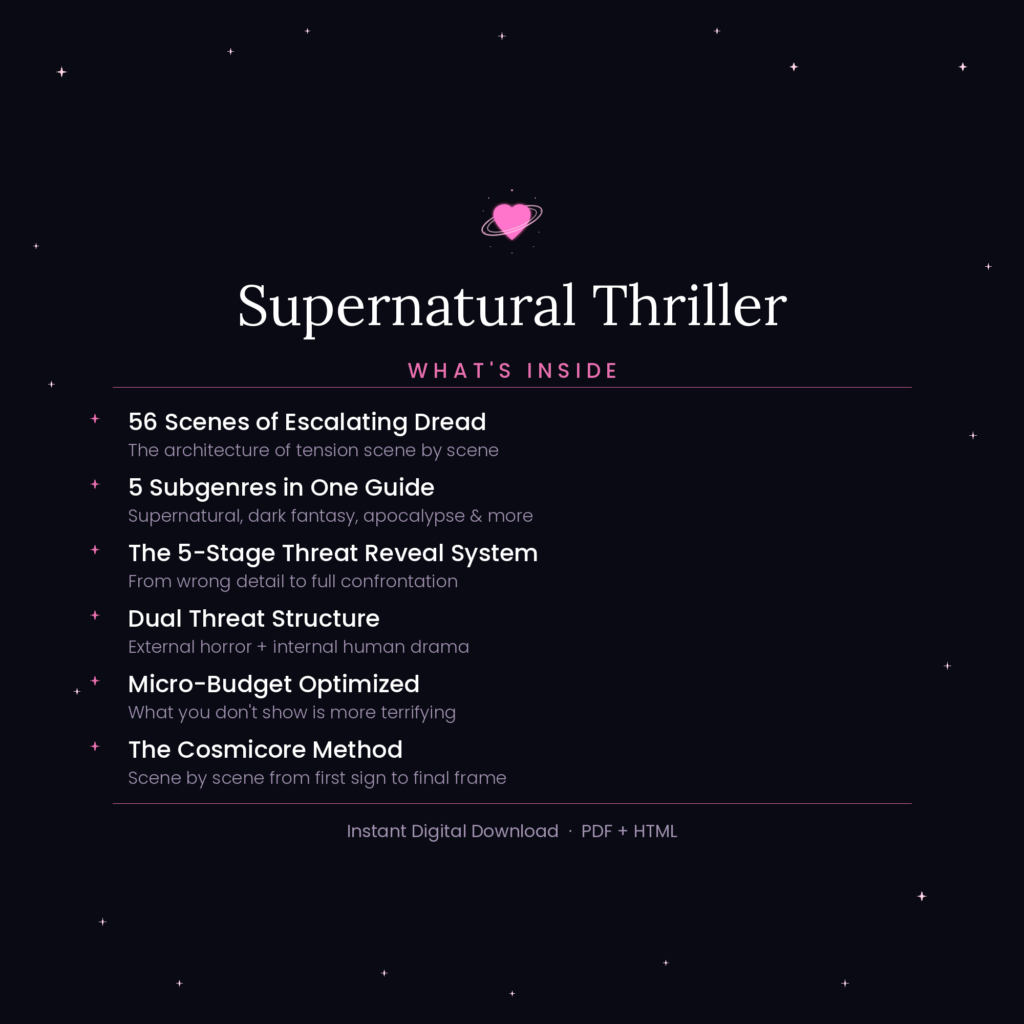
This guide follows the same 56-scene structure as The Cosmicore Screenplay Guide. Target 300–500 words per scene (1.5–2.5 pages), producing a 100–115 page screenplay. Each scene includes genre-specific guidance, a craft note (rose border) for screenwriting technique, and a tension note (dark border) for the genre’s specific architecture of dread. For complete formatting standards, scene heading conventions, and the full screenwriting glossary, refer to The Cosmicore Screenplay Guide.