
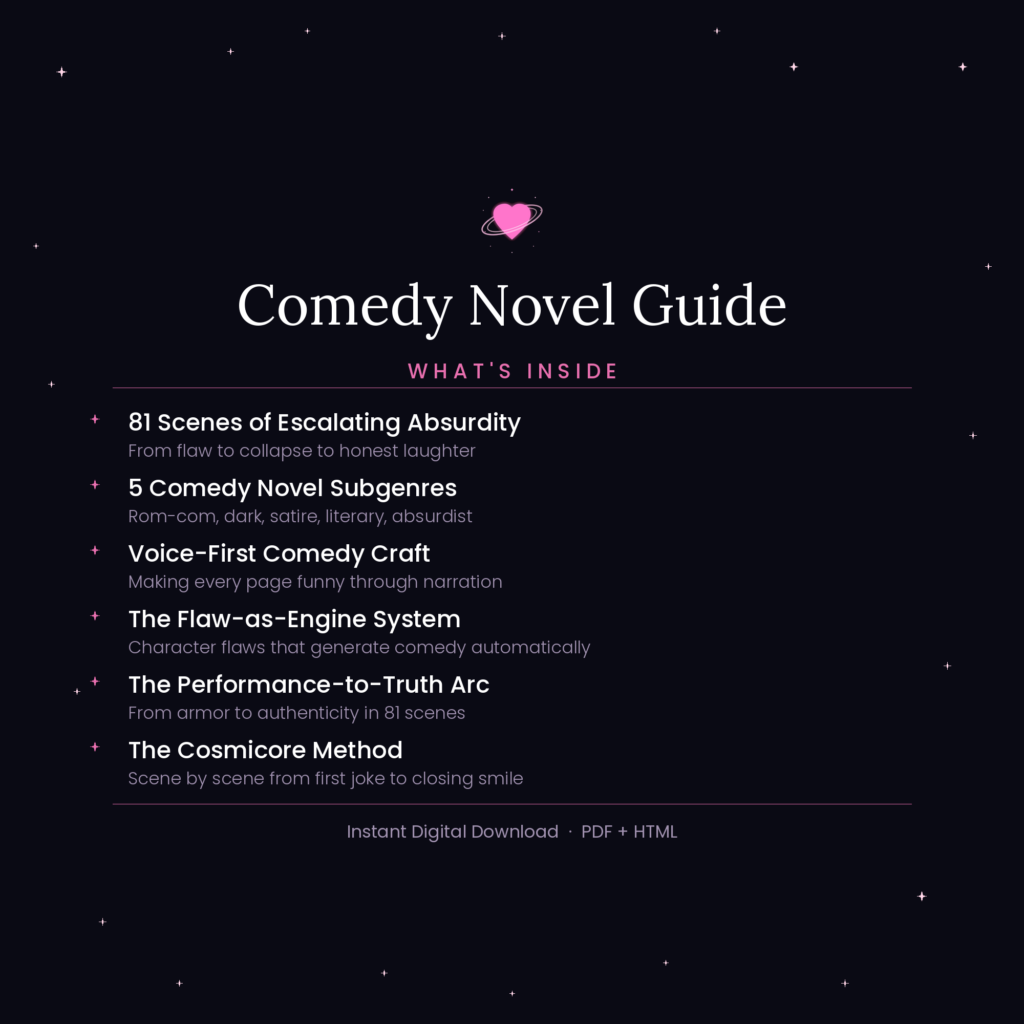
The Comedy Novel Guide is a complete scene-by-scene roadmap for writing novels that make people laugh — and then make the laughter mean something. Comedy fiction is the most technically demanding genre because it requires everything literary fiction requires (complex characters, thematic depth, elegant prose) PLUS the additional demand of being funny on every page. Drama can coast on tension. Comedy cannot coast on anything. Every chapter must earn a reaction — a laugh, a cringe, a snort of recognition, an involuntary “oh no” — or the reader puts the book down. The comedy novel is a performance. The page is the stage. The reader is the audience. And the audience is always one flat joke away from leaving.
This guide covers the spectrum of comic fiction — from romantic comedy to dark satire — unified by one principle: comedy is truth delivered at an angle. The straight delivery of truth is drama. The angled delivery — through exaggeration, irony, absurdity, understatement, misunderstanding, and the specific gap between how people present themselves and who they actually are — is comedy. The angle is what makes the audience laugh. The truth underneath is what makes the laughter stay with them after the book is closed.
The Comedy Novel Subgenres
- Romantic Comedy — Two people who belong together can’t get out of their own way long enough to admit it. The comedy comes from the gap between what they feel and what they say, between who they are and who they perform. Books: Bridget Jones’s Diary, The Rosie Project, Beach Read, Red White & Royal Blue, Attachments
- Comic Literary Fiction — Serious themes explored through a comedic lens — the humor doesn’t diminish the subject but illuminates it from an angle that drama can’t reach. Books: A Man Called Ove, Lessons in Chemistry, Less, Where’d You Go Bernadette, The Storied Life of A.J. Fikry
- Satirical Comedy — Comedy aimed at institutions, social norms, or cultural absurdity — the humor exposes what’s wrong by exaggerating it until the audience can’t ignore it. Books: Catch-22, Don’t Let the Pigeon Drive the Bus (adult equivalent: Good Omens), My Year of Rest and Relaxation, Severance, Convenience Store Woman
- Dark Comedy — Comedy that lives in the territory of death, despair, dysfunction, and disaster — finding the absurd in the terrible, the funny in the painful, the human in the inhuman. Books: A Confederacy of Dunces, The Sellout, Eileen, My Sister the Serial Killer, Bunny
- Absurdist Comedy — Comedy that operates in a world where the rules of logic, physics, or social convention have been broken — the humor comes from characters treating the absurd as normal and the normal as absurd. Books: Good Omens, The Hitchhiker’s Guide to the Galaxy, Lamb, John Dies at the End, Reaper Man
What Makes Comedy Work on the Page
Comedy on the page operates differently than comedy on screen or stage. There is no timing through editing. There is no reaction shot. There is no delivery — no actor’s raised eyebrow or paused beat. The page is silent. The reader creates the timing in their own head, at their own pace. This means the comedy writer’s tools are different:
- Voice is everything. In comedy fiction, the narrator’s voice IS the comedy. The way they describe the world, the way they frame observations, the specific vocabulary they choose — the voice creates a comic lens through which every event becomes funnier than it would be in neutral narration. If your voice isn’t funny, your novel isn’t funny, regardless of how funny the situations are. Voice is not something you add to the story. Voice IS the story.
- Specificity is funnier than generality. “She ate a terrible meal” is not funny. “She ate a lasagna that tasted like a wet carpet had been baked at 350 degrees with a grudge” is funny. Specific, vivid, unexpected comparisons — the metaphor, the simile, the description that takes the reader somewhere they didn’t expect — are the comedy novelist’s primary tool. Every sentence is an opportunity for a specific, surprising image. Not every sentence should contain one (that’s exhausting). But enough should that the reader trusts the voice to take them somewhere unexpected on any given page.
- Character flaws are comedy gold. The funniest characters in fiction are not the ones who tell jokes but the ones whose FLAWS produce comic situations. The control freak in a chaotic world. The people-pleaser who can’t say no. The catastrophizer who turns every minor setback into an existential crisis. The oblivious genius who can solve equations but can’t read a room. The flaw generates comedy automatically — you put the character in situations and the flaw does the work.
- Emotional honesty makes comedy land harder. The reader who laughs at a character AND cares about them laughs harder and longer than the reader who only laughs. The moment of genuine vulnerability — the paragraph where the comedy stops and the character tells the truth about their loneliness, their fear, their heartbreak — doesn’t kill the comedy. It deepens it. When the comedy returns (and it must return quickly), the laughs have more weight because the reader is now emotionally invested. They’re not just amused. They’re amused AND moved. That combination is the holy grail of comic fiction.
The Comedy Novel’s Contract with the Reader
The contract: “We will make you laugh, and then we will make you feel.” The comedy novel promises entertainment — a voice so engaging that the reader doesn’t want to put the book down, situations so absurd they forget they’re reading fiction, characters so vivid they become friends. But the great comedy novel also promises transformation: by the end, the laughter has led somewhere. The protagonist has changed. The reader has changed. The truth that was hidden beneath the humor has surfaced, and the surfacing feels inevitable — like the punchline of a joke that was being set up for 300 pages. The laugh and the feeling are the same thing. That’s the promise. That’s the goal.
Word Count and Pacing
- Total novel: 70,000–90,000 words. Comedy novels tend to be slightly shorter than dramas because comedy requires pace — a comedy that drags is a comedy that dies.
- Per chapter: 2,500–3,300 words (3 scenes × 800–1,100 words). Short chapters are better than long ones. “Just one more chapter” applies to comedy as much as it does to thrillers.
- Laughs per page: Aim for at least one genuine comic moment per page — a funny observation, a surprising metaphor, a character-driven absurdity, a line of dialogue that makes the reader snort. Not a joke-per-line density (that’s exhausting). But a consistent frequency of delight that makes the reader trust the voice to keep entertaining them.