
The Cosmicore Method’s Magical Realism Screenwriting Guide
The Magical Realism Romance Screenplay Guide is a genre-specific companion to The Cosmicore Screenplay Guide. While the flagship guide teaches the universal craft of screenwriting — structure, formatting, spec vs. shooting scripts, and the complete filmmaking vocabulary — this guide goes deep into the specific storytelling techniques that make magical realism romance work on screen. Use this guide alongside the flagship, not instead of it.
This guide covers a family of interconnected genres that share one DNA: a love story transformed by something impossible. The “something impossible” can be time travel, a wish granted, a curse, a magical object, a parallel life, a ghost, a mystical place, a holiday miracle, or the universe itself intervening in the love story. The magic is real within the world of the film — but it serves the romance. The impossible element exists to illuminate something true about love, loss, second chances, or the choices that define a life.
The Genres This Guide Serves
⊹ ࣪ ˖ Magical Realism Romance — The real world with one impossible element woven in. The magic isn’t explained; it’s accepted. Films: Like Water for Chocolate, The Age of Adaline, Big Fish
⊹ ࣪ ˖ Romantic Fantasy — A fantasy premise driving a love story. The fantasy element is the engine; the romance is the destination. Films: Enchanted, The Princess Bride, Stardust
⊹ ࣪ ˖ Romantic Comedy with a Fantasy Twist — Classic rom-com structure with an impossible “what if.” Films: Groundhog Day, 13 Going on 30, What If (The F Word)
⊹ ࣪ ˖ Time-Bending Romance — Love across time, through time, or because of time. Films: About Time, Peggy Sue Got Married, The Time Traveler’s Wife, Somewhere in Time, Midnight in Paris
⊹ ࣪ ˖ Second-Chance Fantasy — A character gets to see the life they didn’t choose. Films: The Family Man, It’s a Wonderful Life, Mr. Destiny
⊹ ࣪ ˖ Holiday Romance with Magical Elements — The Christmas (or holiday) movie where something magical happens. Films: The Holiday (tonally), The Christmas Chronicles, A Christmas Carol adaptations, the entire Hallmark magical Christmas category
What Makes This Genre Work on Screen
The magic is never the point. The magic is the mechanism that forces the protagonist to confront the truth about love. In Groundhog Day, the time loop isn’t the story — Phil learning to genuinely love someone is the story. In The Family Man, the alternate life isn’t the story — Jack discovering what he actually wants is the story. In About Time, time travel isn’t the story — Tim learning to live each day fully is the story. The impossible element is the microscope. Love is the specimen.
This means the screenwriter’s job in magical realism romance is dual: build a magical system that the audience accepts AND build a love story that the audience feels. The magical system must have rules (even if unspoken). The love story must have obstacles (even if unconventional). And the two must be inseparable — the magic should create, complicate, or illuminate the romantic conflict in ways that would be impossible without it.
The Magical Realism Romance Contract with the Audience
The audience agrees to believe one impossible thing in exchange for an emotionally true love story. This is the genre’s contract. Break either half and the film fails. If the magic is present but the love story is shallow, the audience feels manipulated by whimsy. If the love story is deep but the magic is inconsistent or arbitrary, the audience loses trust in the world. The magic and the romance must earn each other.
Word Count Targets
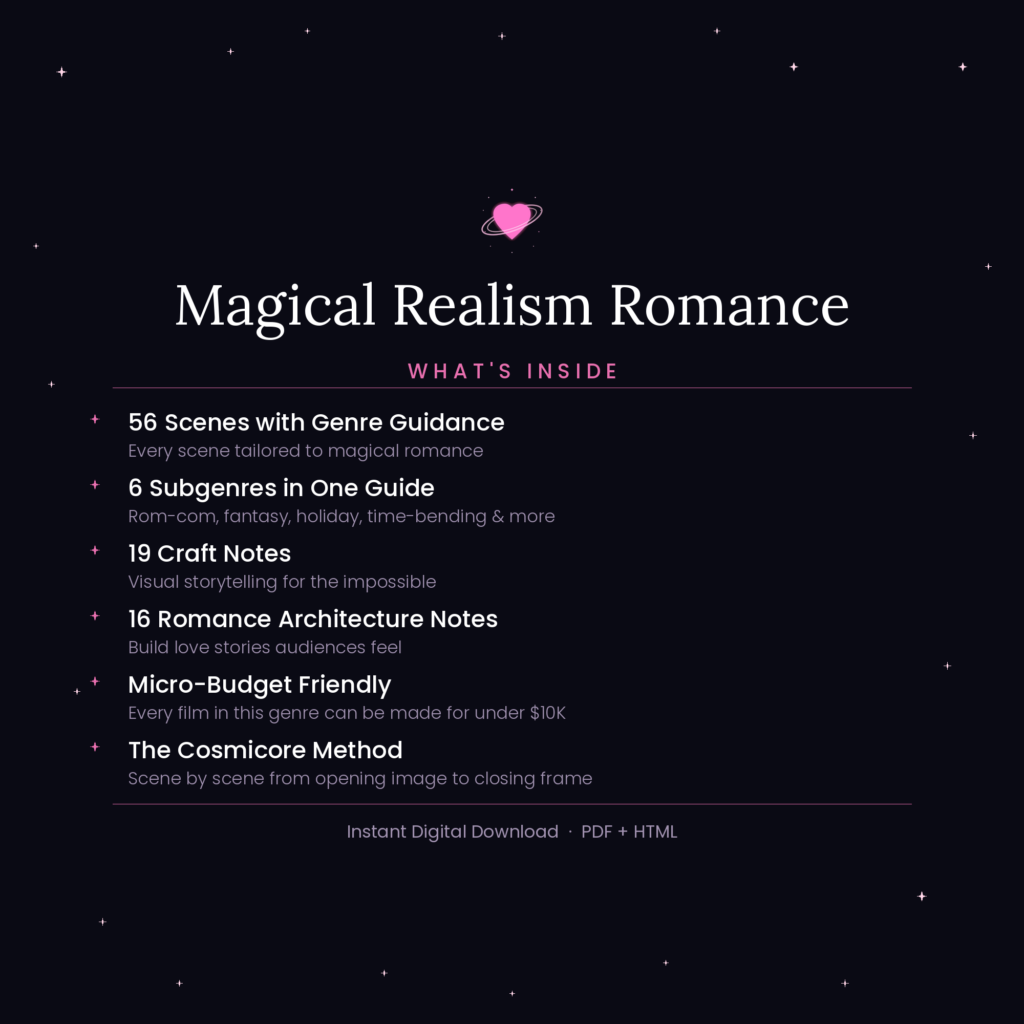
This guide follows the same 56-scene structure as The Cosmicore Screenplay Guide. Target 300–500 words per scene (1.5–2.5 pages), producing a 100–115 page screenplay. Each scene includes genre-specific guidance, a craft note (rose border) for screenwriting technique, and a romance note (dark border) for the love story’s emotional architecture. For complete formatting standards, scene heading conventions, and the full screenwriting glossary, refer to The Cosmicore Screenplay Guide.