
The Cosmicore Method’s Paranormal Romance Novel Writing Guide
Unzip the download and you will find the terms, PDF and HTML file of the Paranormal Romance Novel Writing Guide
This guide was made from a method that helps me write scene by scene. I hope it helps you. ⊹ ࣪ ˖
What Is the Cosmicore Method?
The Cosmicore Method is built on one principle: a writer should never face a blank page without knowing what to write next.
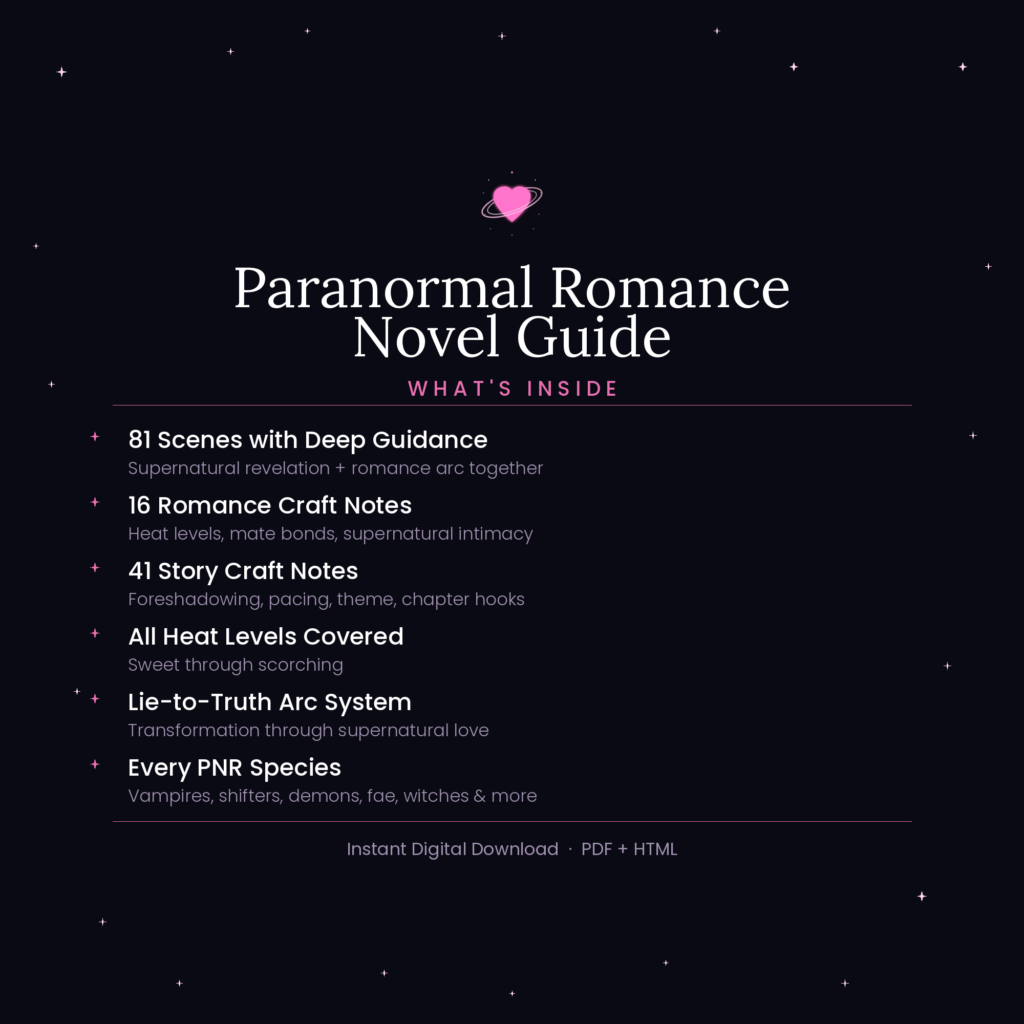
Writer’s block is a structure problem, not a creativity problem. The Cosmicore Method breaks the novel into 81 individual scenes, each with a clear purpose, a specific narrative function, and genre-adapted craft guidance. You never write a novel. You write one scene. Then you write the next one.
Why 27 Chapters & 3 Scenes?
⊹ ࣪ ˖ 3 scenes build a chapter — each chapter is a micro-arc with its own setup, development, and payoff
⊹ ࣪ ˖ 9 chapters build an act — each act escalates the supernatural danger and deepens the forbidden attraction
⊹ ࣪ ˖ 3 acts build a novel — the classic three-act structure, adapted for PNR’s dual revelation: the supernatural world and the love that survives discovering it
The fractal rhythm of setup → confrontation → resolution repeats at every level. In paranormal romance, this rhythm produces escalating intimacy alongside escalating danger — each chapter makes the love more undeniable and the supernatural threat more lethal, until the two collide in a climax where the protagonist must choose the lover whose nature terrifies them or lose them forever.
Word Count
At 1,000 to 1,500 words per scene, the method produces a novel of 81,000 to 121,500 words — the standard range for paranormal romance. Each scene represents roughly 45 minutes to 2 hours of focused writing.
Target per scene: 1,000–1,500 words. Intimate scenes and action sequences may run longer. Revelations and transitions may run shorter. PNR readers expect heat and momentum — keep both flowing.
How to Use This Guide
⊹ ࣪ ˖ Start at Scene 1.1 and work through in order — the sequence paces both the supernatural revelation and the romantic escalation
⊹ ࣪ ˖ All guidance lives inside the scene where that writing takes place
⊹ ࣪ ˖ Craft notes (rose left border) cover story structure, world-building, pacing, and tension
⊹ ࣪ ˖ Romance notes (dark left border) cover heat levels, supernatural intimacy, mate bonds, and the specific beats that make PNR readers devour books at 3 AM
⊹ ࣪ ˖ Every Scene X.3 should end with a hook that pulls the reader into the next chapter
This Is a Guide, Not a Rulebook
Your creativity comes first. This guide is a framework, not a constraint. If your story needs you to combine scenes, rearrange chapters, or break from the structure — do that. The best PNR writers understand structure well enough to know exactly when to deviate. This guide is a launchpad. The story — the dark, electric, consuming story — is yours.
The Range of Paranormal Romance
This guide covers the full spectrum of PNR without splitting into subgenres. Every scene’s guidance applies whether you’re writing:
⊹ ࣪ ˖ Vampire romance — immortal desire, blood as intimacy, the predator who falls for prey
⊹ ࣪ ˖ Shifter romance — the animal and the human coexisting, the mate bond, pack dynamics as relationship context
⊹ ࣪ ˖ Demon/angel romance — celestial politics, forbidden crossing, the divine and the damned finding each other
⊹ ࣪ ˖ Witch/warlock romance — magic as power and vulnerability, covens as community, spellwork as metaphor for desire
⊹ ࣪ ˖ Ghost/spirit romance — love across the veil, the living and the dead, time and memory as romantic obstacles
⊹ ࣪ ˖ Fae-in-the-modern-world — ancient beings walking contemporary streets, glamour as deception, bargains as courtship
⊹ ࣪ ˖ Hybrid/unique creatures — gargoyles, dragons, phoenixes, reapers, or beings of your own invention
⊹ ࣪ ˖ Reverse harem / why choose — multiple supernatural love interests, each with a different paranormal nature
⊹ ࣪ ˖ Any heat level from sweet to scorching — this guide marks heat-level decision points throughout